
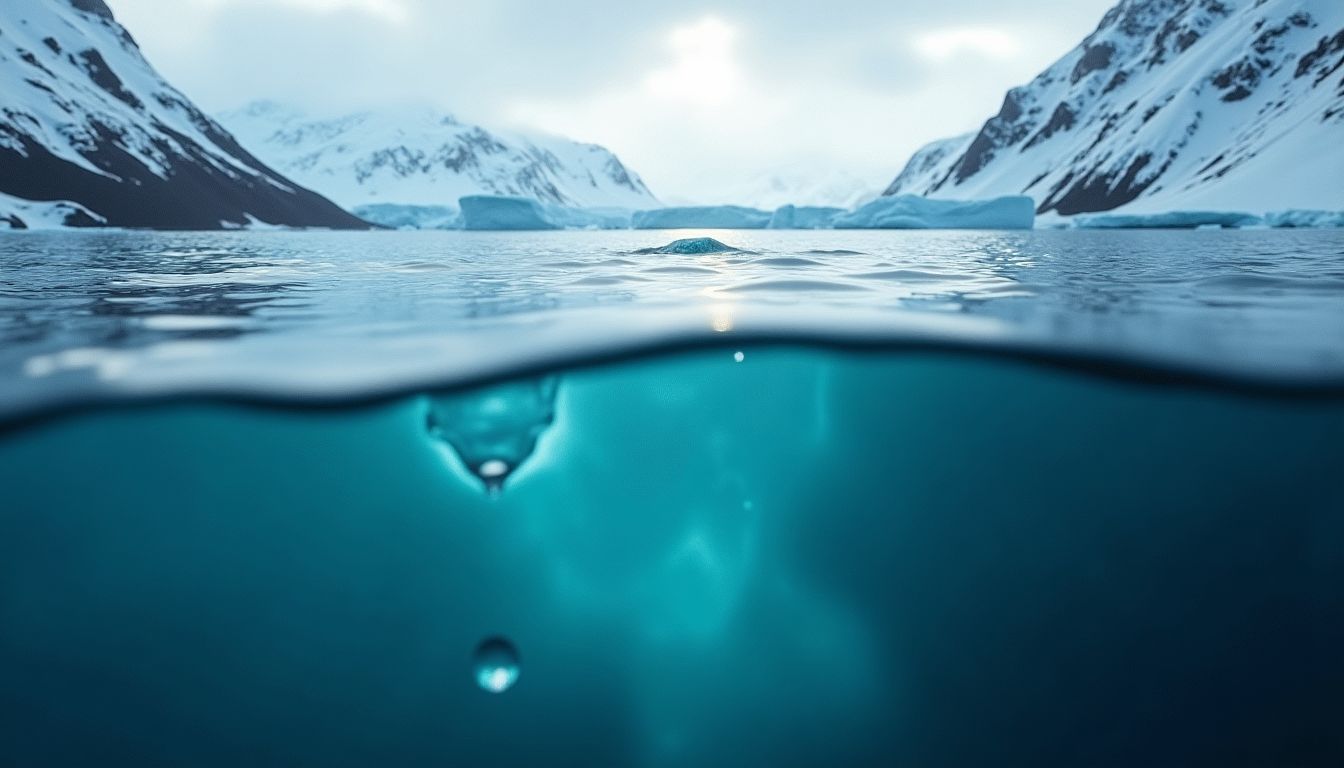
You know that feeling when you see something so strikingly beautiful that your brain just... pauses? That's exactly what's happening with images of the deep, electric blue color found at the bottom of icebergs. It's the kind of visual that makes you forget you were in the middle of scrolling and forces you to actually stop and look. And honestly? It makes complete sense why people can't get enough of it.
Here's the science that makes it so fascinating. That mesmerizing dark blue color isn't a trick of lighting or camera filters — it's the real deal. Ice that has been compressed under enormous pressure for thousands of years loses virtually all of its air bubbles, becoming so dense that it absorbs the red end of the light spectrum and transmits only deep, ancient blue. You're literally looking at water that has been frozen since before modern civilization existed. That's not just pretty — that's humbling in a way that hits differently.
There's also something deeply psychological about what we're seeing here. Humans are fundamentally wired to be attracted to things that reveal a hidden layer beneath the surface — quite literally in this case. Most of an iceberg sits underwater, unseen, mysterious. When someone captures that submerged world and brings it into view, it triggers something primal in us. It's the same reason we love deep-sea footage or cave exploration videos. We are obsessed with what exists just beyond our ordinary perception.
The timing of this moment matters too. We're living through a period where climate conversations have become exhausting, politicized, and frankly kind of numbing. But an image like this sidesteps all of that noise completely. It doesn't lecture you — it just shows you something ancient and irreplaceable and lets you feel whatever you're going to feel. That's a far more powerful communication tool than any infographic or statistic. It reconnects people to the natural world through pure, uncomplicated wonder rather than guilt or anxiety.
There's also a "next f***ing level" quality to this that taps into our collective appetite for things that shatter our assumptions about everyday objects. Ice, right? We all know ice. We put it in our drinks. We complain when roads get slippery. But ancient glacial ice compressed over millennia into something that glows like a sapphire from the deep ocean? That's ice revealing itself as something almost supernatural. It reframes the ordinary into the extraordinary, which is basically the most viral formula that exists in human attention economics.
What makes this particular moment unique is that it arrives at a time when people are genuinely hungry for beauty that feels real and unmanufactured. In a content landscape absolutely saturated with filters, AI-generated imagery, and carefully curated aesthetics, something that looks this otherworldly but is completely, verifiably natural carries enormous emotional weight. People aren't just sharing it because it looks cool — they're sharing it because it feels like proof that the real world is still more spectacular than anything we could invent.
At its core, this iceberg image is doing what the best viral content always does — it makes you feel small in the best possible way. It reminds you that the planet has been quietly doing extraordinary things for millions of years without needing our attention or approval. And sometimes, in the middle of an ordinary Tuesday, stumbling across proof of that is exactly the perspective reset a person needs. That shade of blue isn't just a color. It's time itself, made visible.