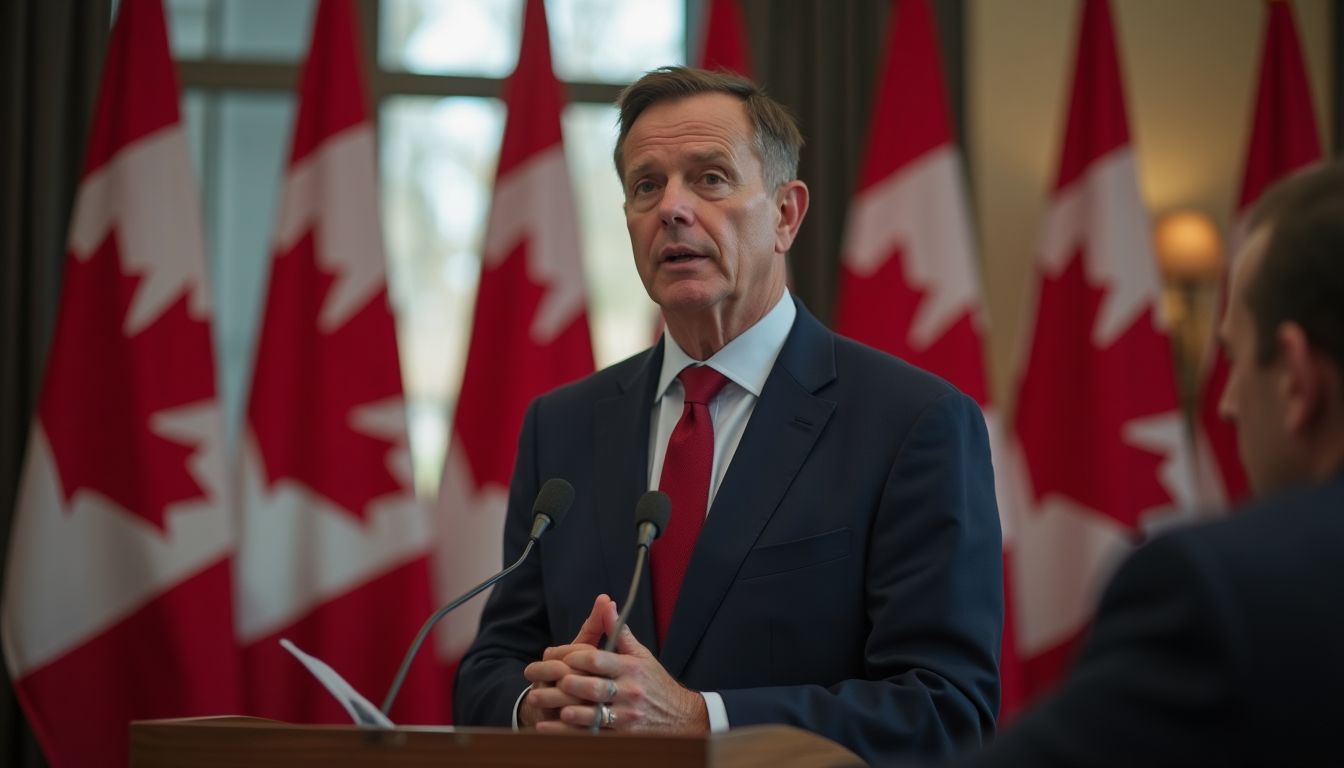
There's something almost refreshing about a government official just... saying it. No diplomatic tap-dancing, no carefully worded ambiguity designed to please everyone and commit to nothing. Canada's defence minister came out and flatly stated the country will not be participating in any war with Iran. Full stop. In a geopolitical moment where most world leaders are carefully hedging every syllable, that kind of directness hits differently.
The timing here is everything. Tensions involving Iran have been simmering at varying levels of intensity for years, but right now the temperature is elevated enough that countries are quietly being asked where they stand. That's the invisible pressure cooker behind this story. When Canada makes a public declaration like this, it's not just answering a hypothetical — it's responding to very real conversations happening behind closed doors among Western allies.
Here's what makes this culturally significant beyond the geopolitics: Canadians have long wrestled with their national identity in relation to their American neighbors. There's a constant, sometimes exhausting negotiation between being a close ally and being distinctly, defiantly *not* American. This statement lands right in the middle of that tension. It's Canada essentially saying "we have our own foreign policy, thanks," and for a lot of people — Canadian or not — that assertion of independence from a larger power's orbit feels genuinely meaningful right now.
There's also the very human element of war fatigue playing into why this resonates so deeply. The world has watched prolonged conflicts grind on for years, and populations in Western countries are increasingly skeptical about military entanglements that feel distant, complex, and costly in every sense of the word. A government official explicitly opting out speaks directly to that exhaustion. It validates what a lot of ordinary people are quietly feeling but rarely hear reflected in official government language.
The Iran dimension specifically adds another layer of complexity. Iran sits at the center of one of the most layered geopolitical puzzles on the planet — nuclear ambitions, proxy conflicts, regional power dynamics, and a history of volatile diplomatic flashpoints with the West. Any news involving Iran carries an automatic weight because people understand, even instinctively, that the stakes are extraordinarily high. When a G7 nation publicly distances itself from potential military action involving Iran, that's not a minor footnote. That's a meaningful signal about where international consensus may or may not exist.
What makes this moment particularly unique is the transparency of it. Foreign policy usually operates in a language of careful obfuscation — "we are monitoring the situation," "all options remain on the table," "we stand with our allies." Canada just skipped all that and said no. There's an almost startling clarity to it that cuts through the usual noise. People are drawn to clarity right now because it's genuinely rare, and when a government delivers it on something as serious as war, it commands attention in a way that typical political statements simply don't.
Ultimately, this story captures something bigger than one country's military policy. It's about the fractures and negotiations happening within Western alliances, the growing public pushback against reflexive military involvement, and a small but significant assertion that countries can and do chart their own course. Whether you agree with Canada's position or not, the boldness of saying it publicly — clearly, without hedging — is the thing that sticks. In a world drowning in political noise, a simple declarative sentence from a defence minister somehow manages to cut right through it all.