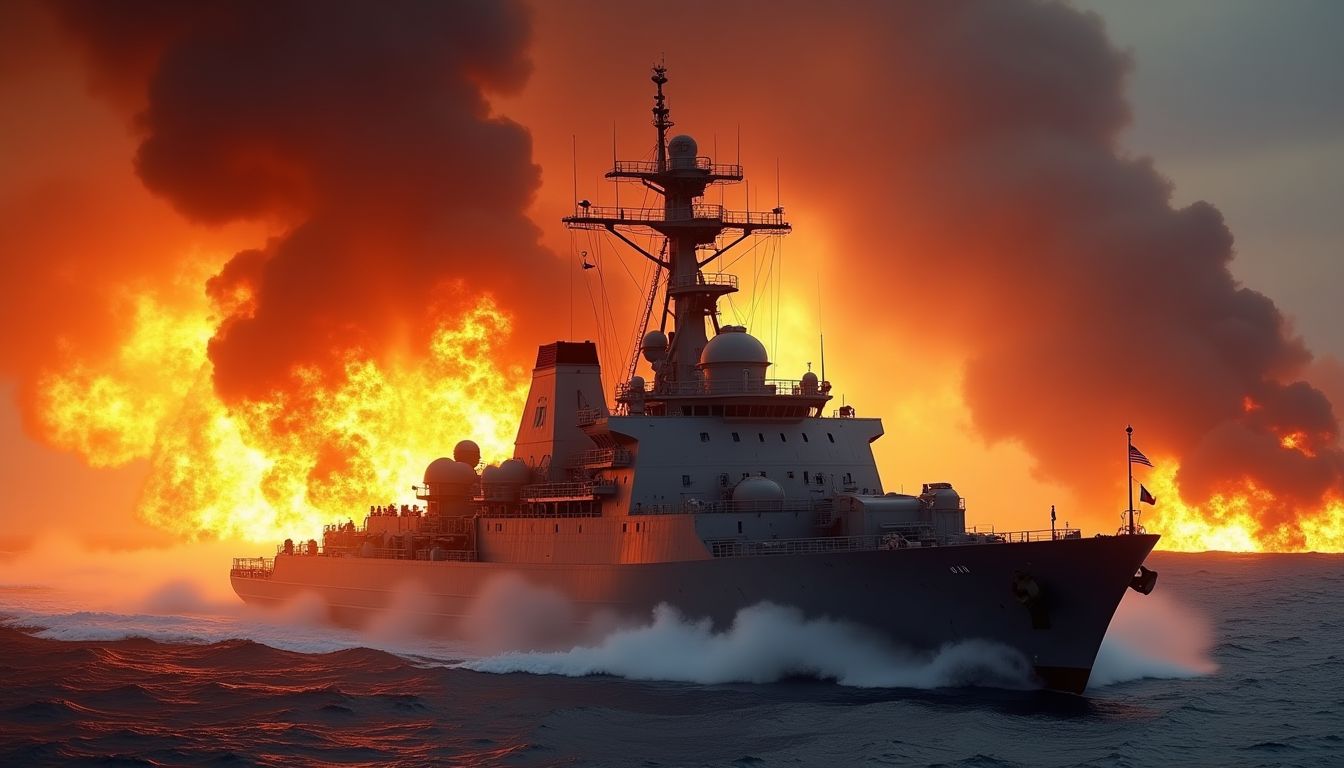
Let's just sit with this for a second. The USS Gerald R. Ford — one of the most advanced aircraft carriers ever built, literally named after a U.S. president — was deployed in active operations related to a conflict with Iran, caught fire, and now needs to pull into port. That sentence alone contains roughly four different news stories that would each individually stop you mid-scroll. Combined? It's the kind of headline that makes your brain do a double-take and go back to read it again.
The reason this story hits differently right now is context. We're not talking about a peacetime training exercise gone wrong. This ship was actively positioned in one of the most volatile geopolitical flashpoints on the planet. A conflict with Iran isn't a hypothetical anymore — it's the operating environment. So when something as dramatic and unexpected as a fire disrupts that mission, it forces a very real question into the public consciousness: just how deep into this are we, and what happens when things go sideways?
There's also something deeply human about the vulnerability of massive military power. The Ford-class carrier is essentially a floating city. It costs around $13 billion dollars. It carries thousands of sailors, dozens of aircraft, and represents the absolute peak of American naval engineering. And yet — fire. It's the kind of story that quietly reminds people that no matter how sophisticated the technology, the chaos of real-world conflict doesn't care about price tags or prestige. That tension between invincibility and fragility is genuinely gripping.
The Iran angle amplifies everything. U.S.-Iran relations carry decades of historical baggage — from the 1979 hostage crisis to nuclear deal negotiations to proxy conflicts across the region. For a lot of people, the idea of direct military engagement with Iran feels like a threshold being crossed, not just another foreign policy chapter. When you layer a carrier fire on top of that already-charged backdrop, it starts to feel less like a news story and more like a scene from a very stressful movie that nobody bought a ticket to.
There's a generational dimension here too. Younger audiences who came of age after 9/11 watched two decades of grinding wars in Afghanistan and Iraq. There's a kind of war-weariness baked into the cultural DNA at this point. So when a story emerges suggesting active, high-stakes naval deployment in a new conflict zone — complete with a dramatic incident requiring the ship to stand down — it triggers a very specific anxiety. People want to know: is this the beginning of something? Are we watching the opening act?
And honestly, the story also just works on a pure information level. It's specific, it's visual, it's consequential. You can picture a massive warship. You understand what fire means on a vessel at sea. You know what Iran represents in global politics. The story doesn't require a deep briefing to feel important — it lands immediately. That accessibility, combined with the genuine stakes involved, is exactly why this kind of story cuts through the noise in a way that dense policy debates rarely do.
At its core, this story is capturing attention because it makes an abstract conflict suddenly, viscerally real. Military deployments can feel distant and theoretical until something goes wrong in a very concrete, tangible way. A fire. A detour to port. A disruption to the mission. These aren't just operational details — they're reminders that real people are out there, real machinery can fail, and real consequences follow. That's not just news. That's the kind of story that stays with you.