
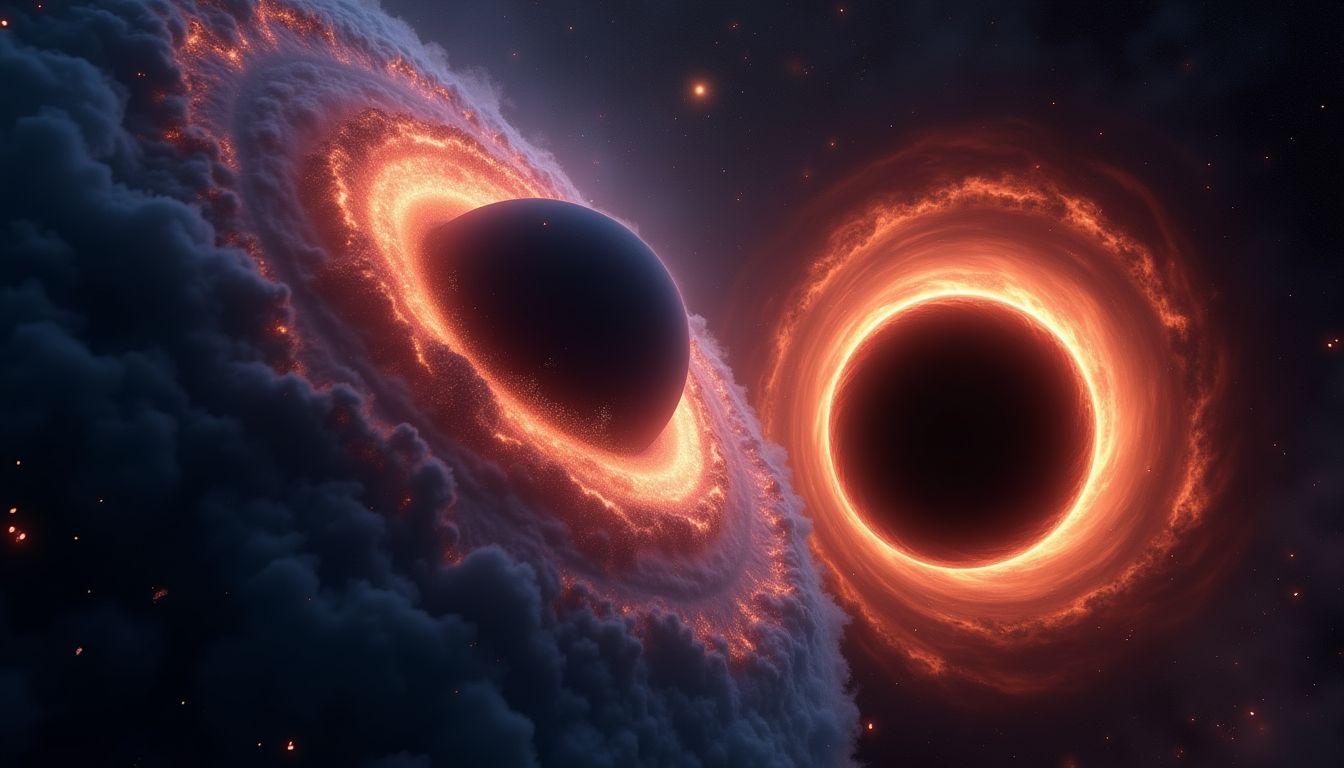
Rare Double Black Hole System Observed Through Unique Jet Formation
Astronomers have made an unprecedented observation of two supermassive black holes locked in a tight orbital relationship within a distant galaxy, according to new research by Passant Rabie. The discovery was made possible through the detection of an unusual double jet system that revealed the pair of massive objects are positioned extremely close to each other.
Unprecedented Astronomical Discovery
The research describes what scientists are calling a tight death spiral between the two supermassive black holes. This rare configuration was identified through the observation of dual jets emanating from the distant galaxy, a phenomenon that had not been previously documented in such detail.
Supermassive black holes, which contain millions to billions of times the mass of our Sun, typically reside at the centers of galaxies. When two galaxies merge, their central black holes can eventually form binary systems like the one described in this research.
Significance of the Double Jet System
The unexpected double jet formation served as the key indicator that allowed researchers to identify this binary black hole system. Jets are high-energy streams of particles that are ejected from the regions around black holes at near light-speed. The presence of two distinct jet systems in close proximity provided the evidence needed to confirm the existence of the paired supermassive black holes.
Binary supermassive black holes represent one of the most extreme environments in the universe. As these objects orbit each other, they gradually lose energy and spiral inward, eventually leading to a collision that would produce gravitational waves detectable by space-based observatories.
Implications for Astronomical Understanding
This observation provides valuable insight into the behavior of supermassive black holes in binary configurations. The tight orbital relationship described in the research suggests these objects are in the final stages before merger, offering astronomers a rare opportunity to study the dynamics of such systems.
The discovery adds to the growing body of evidence supporting theories about how supermassive black holes evolve and interact within galactic environments, particularly during galaxy merger events that bring multiple black holes into close proximity.