
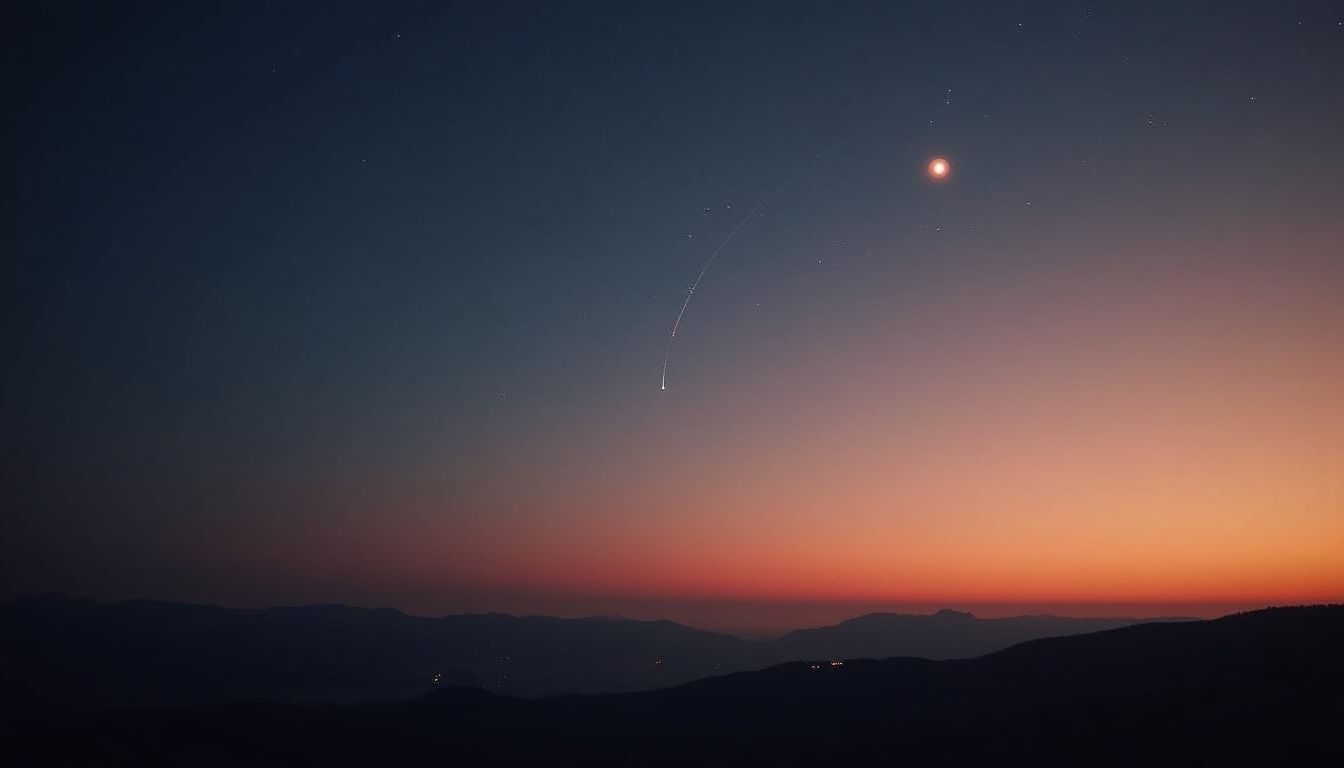
Mercury moved north of Venus in the western evening sky on Thursday, February 26, creating a notable celestial alignment visible to observers shortly after sunset. The two planets appeared close together in the deepening twilight, offering stargazers a brief window to witness this planetary conjunction before both celestial bodies set below the horizon.
The astronomical event marks a significant moment in the ongoing dance between the two inner planets of our solar system. Venus, often called the "evening star" when visible after sunset, has been joined by Mercury in the western sky. Both planets are currently visible together for a limited time each evening, with their proximity creating an easily observable pairing for amateur astronomers and casual sky watchers alike.
Mercury's northward movement relative to Venus represents the natural progression of planetary motions as seen from Earth. The swift planet Mercury, which completes its orbit around the Sun in just 88 Earth days, regularly changes position relative to other planets. This particular alignment occurs as both planets appear in the same general region of sky from Earth's perspective, though they remain millions of miles apart in actual distance.
The viewing opportunity requires observers to look west shortly after sunset, during the brief twilight period when the sky is dark enough to see the planets but before they set below the horizon. Urban observers may need to find locations with clear western horizons, away from buildings and other obstructions. The planets appear as bright points of light, with Venus typically being the more brilliant of the two due to its reflective cloud cover.
This celestial event is part of a series of astronomical phenomena occurring this week. The previous day, February 25, featured Ganymede transiting across Jupiter, with the large Jovian moon moving away from Jupiter's southwestern limb while its shadow prepared to cross the planet's surface. These back-to-back events provide multiple opportunities for sky enthusiasts to observe planetary activity.
The Mercury-Venus conjunction represents one of the more accessible astronomical events for public viewing, requiring no special equipment beyond the naked eye. However, binoculars can enhance the viewing experience by making both planets appear brighter and easier to distinguish. The brief viewing window each evening makes timing crucial for observers hoping to catch this planetary pairing.
As the planets continue their respective orbits, this close appearance will gradually change over the coming days and weeks. Mercury's rapid orbital motion means such alignments are typically short-lived, making this week's viewing opportunity particularly noteworthy for those interested in observing planetary motions firsthand.