
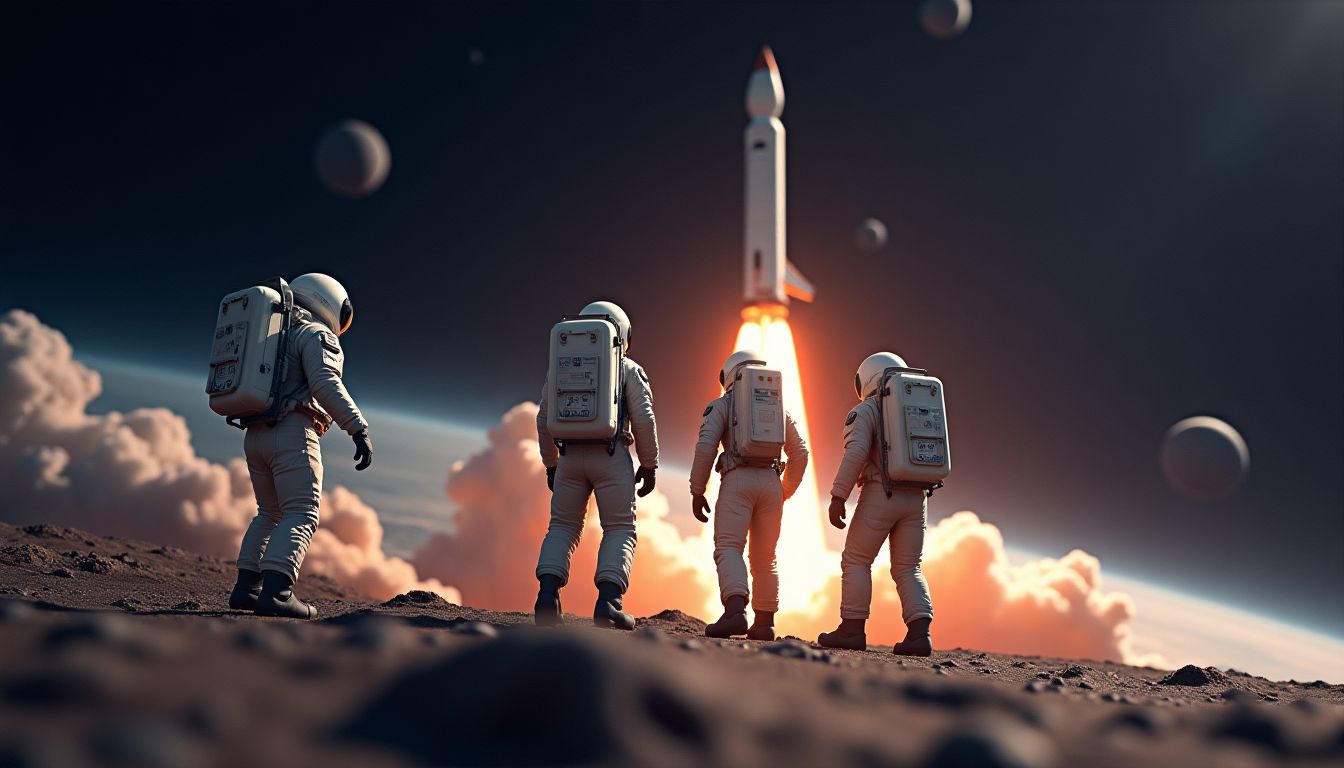
The crew consists of NASA astronauts Reid Wiseman, Victor Glover, and Christina Koch, along with Canadian Space Agency astronaut Jeremy Hansen. Wiseman serves as mission commander, while Glover is the pilot. Koch and Hansen round out the four-person crew for what is scheduled to be a nine-day voyage around the Moon before splashing down in the Pacific Ocean.
The crew lifted off aboard NASA's Space Launch System, a 322-foot rocket that is currently the most powerful launch vehicle in operation. The SLS generated approximately 8.8 million pounds of thrust at liftoff, surpassing even the Saturn V rockets used during the Apollo program. The Orion spacecraft, which houses the crew, is designed to carry astronauts on deep space missions and has undergone extensive testing, including an uncrewed lunar flyby during the Artemis I mission in 2022.
The Artemis II trajectory will take the crew on a free-return path around the Moon, meaning the spacecraft's flight path is designed so that lunar gravity will slingshot the crew back toward Earth without requiring a powered engine burn. The crew will not land on the Moon during this mission, but will venture farther from Earth than any humans have traveled before, surpassing the distance record set by Apollo 13 in 1970. At its farthest point, the Orion spacecraft is expected to travel approximately 230,000 miles from Earth.
The Artemis program is NASA's long-term initiative to return humans to the lunar surface, with a crewed landing targeted for a future mission designated Artemis III. Wednesday's launch represents a significant milestone in that effort, serving as the critical test of the Orion spacecraft's life support, navigation, and communication systems with humans aboard. Mission controllers at NASA's Johnson Space Center in Houston will monitor the crew around the clock throughout the nine-day flight.
The launch drew large crowds to the Florida Space Coast, with hundreds of thousands of spectators gathering to witness the event. NASA administrators and officials from international partner agencies were present at Kennedy Space Center for the liftoff. If the mission proceeds as planned, the crew is expected to splash down in the Pacific Ocean approximately nine days after launch, with recovery ships already positioned to retrieve the Orion capsule and its crew.